How can young people manage their stress levels during exam time? Kathy Knott, a counselling psychologist and Bridging Year Academy programme manager at GWF, says it’s important to “work smarter, not harder”.
She says getting enough sleep, practising good “digital hygiene” and breaking up tasks into small, manageable chunks hold the key to coping during mid-year exams or finals.

Good Work Foundation’s Kathy Knott.
Kathy has compiled five hacks for winning at your exams
1. Sleep time! Get rest for success
“Sleep is the bedrock of physical and mental health, and it helps with committing things to memory,” says Kathy. She recommends between seven and nine hours a night and to aim for consistency (go to sleep and wake up at more or less the same time) and quality (ensuring that you move through the full circadian cycle).
Watch this “Sleep is your superpower” TED Talk video by sleep scientist Matt Walker for more insights.
2. Practise good digital hygiene
Put your phone away when studying! “There’s been a lot of research to show that people who study without their phone in the room get better grades,” says Kathy.
“Because even if your phone is on your desk in silent mode, it continues to distract you from being able to do what we call deep work, which is when you really get into learning and are growing the connections in your brain.” And when you go to bed, charge your phone in another room.
3. Apply the Pomodoro Technique to your studies
This is a time management technique that breaks a task into small, manageable chunks, or “pomodoros”, helping you focus. Set a timer to study undistracted for 25 minutes and then take a five-minute “brain break”.
“You can only concentrate optimally for a certain amount of time before your focus drops off a cliff,” says Kathy. “So study for 20 or 25 minutes, get away from your desk, go to the toilet, phone a friend or eat an apple, and then come back, with your tank filled up and your focus high again. Then take a longer break after four of those sessions.”
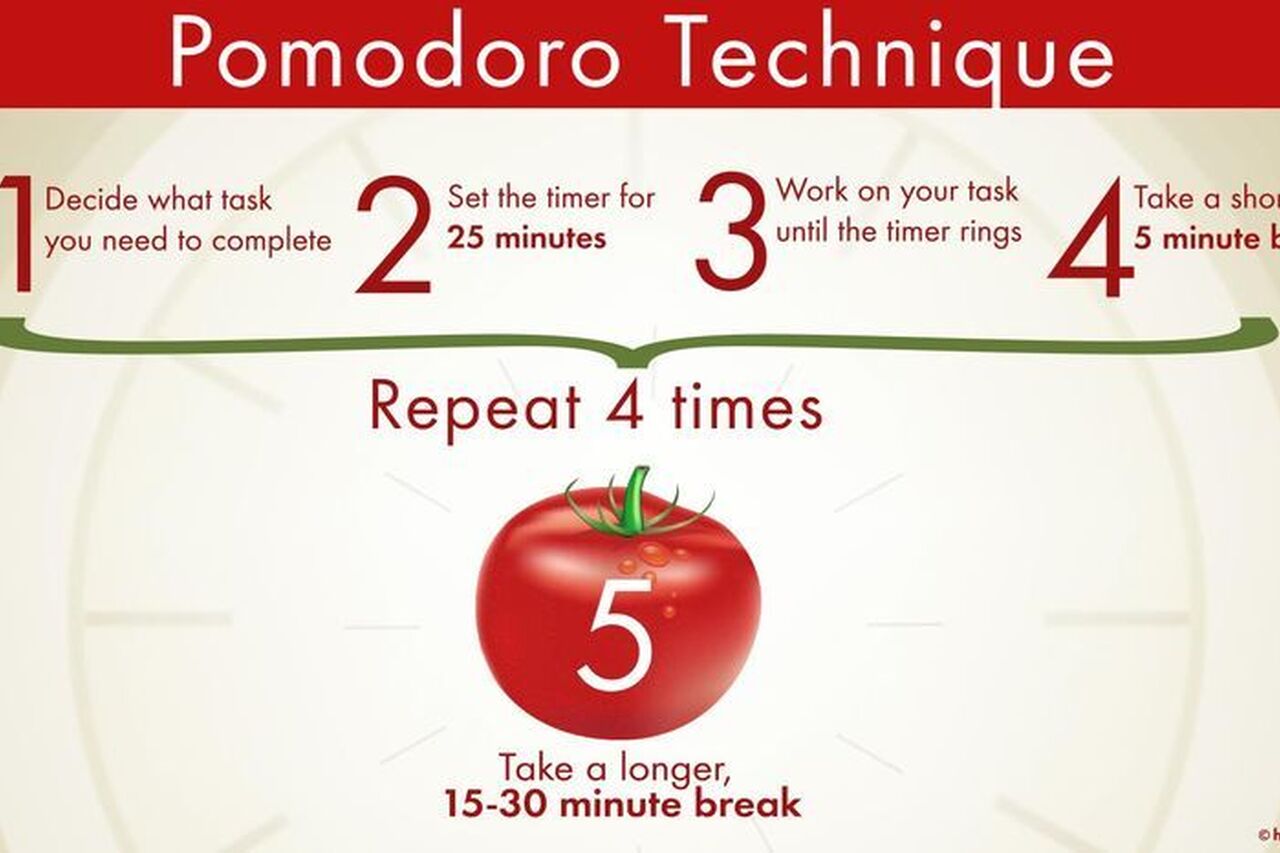
The Pomodoro Technique illustrated. (image: howstuffworks)
4. Find out which study method works best for you
It’s seldom enough to just read through your notes in preparation for an exam, says Kathy. “Research has shown that when people practise active recall when they study, it’s almost like practising where to fetch the information from.”
Here, doing past papers is effective, simulating the test environment. This method suits introverts particularly well. Having a study group or tutoring a friend is also a great way to identify your weak points, especially if you’re an extrovert.
5. Embrace ‘eustress’, or positive stress
Bad stress can be debilitating, but good stress – called eustress – is characterised by feelings of excitement and motivation. “Eustress is the stress that allows you to run that race, give that talk, meet that deadline or ask that guy or girl out. It’s anxiety or nervousness that galvanises you and gets your blood pumping – in a good way. It focuses you and gives you energy,” says Kathy.
For tests and exams, get into the eustress zone – not so stressed that your brain freezes, and not so chilled out that you battle to focus.
“When we’re in distress, we need to learn coping mechanisms to dial back into the eustress zone. And when we’re too low, we must get up into that eustress zone in the middle, when we’re in a flow state.”